

Multi-Parameter vs Single-Device: Why All-in-One Matters
Multi-Parameter vs Single-Device: Why All-in-One Matters
Picture a rural health post in Nepal. One room. Limited power. A single health worker serving an entire village.
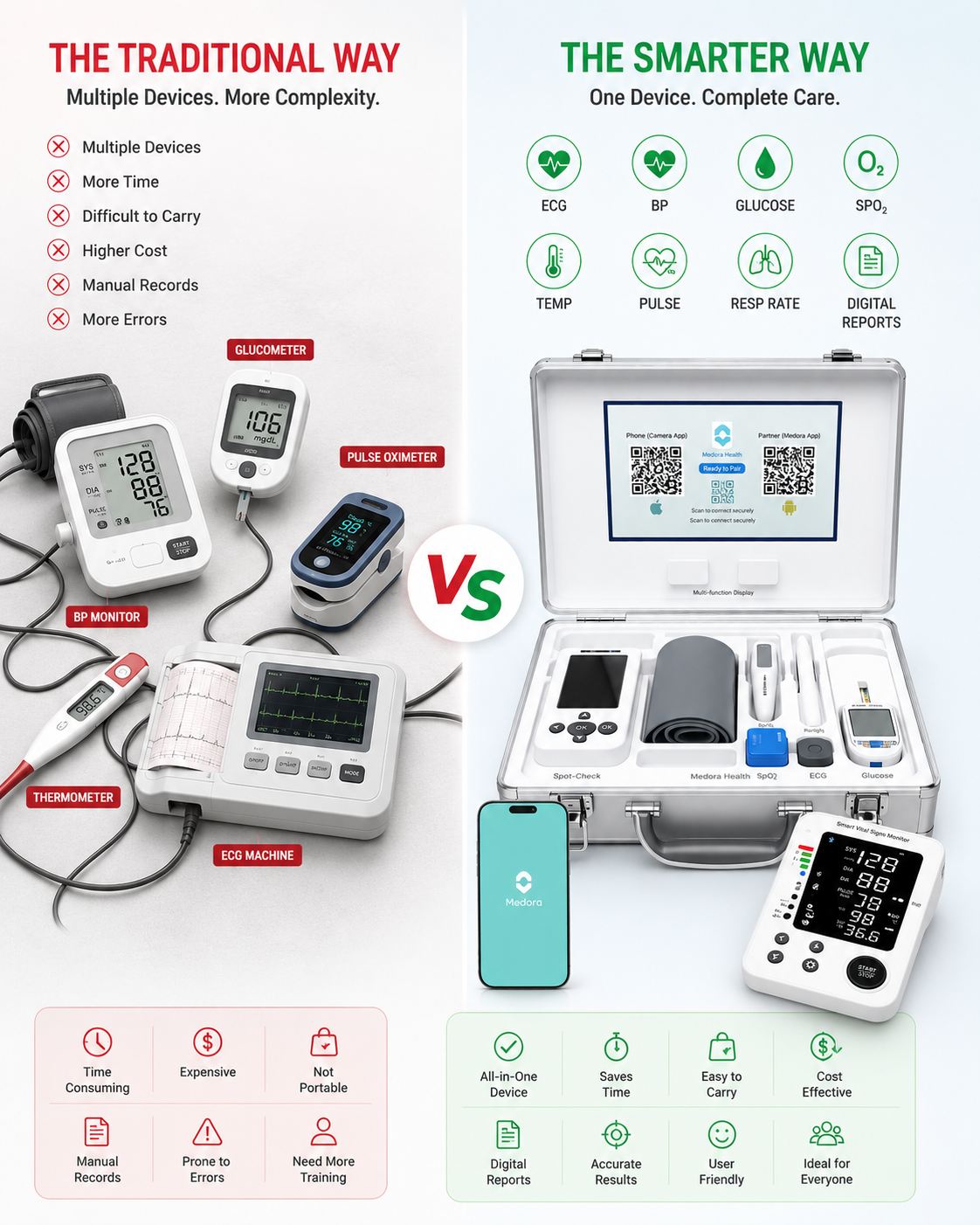
On the table sit five separate devices — a blood pressure monitor, a glucometer, a pulse oximeter, a thermometer, and an ECG machine. Each has its own battery, its own instruction manual, and its own way of storing data. The health worker spends more time switching between devices than focusing on the patient.
This is the reality for many clinics and health posts across Nepal. But it doesn’t have to be this way.
Multi-parameter all-in-one health monitors are changing the landscape of diagnostic healthcare — and for Nepal, the shift from single-device to multi-device systems is more than a convenience. It is a necessity.
The Old Way: A Cabinet Full of Devices
In the traditional single-device approach, clinics purchase one device for each vital sign they want to measure. Over time, the clinic accumulates:
- A standalone blood pressure monitor
- A separate glucometer
- A pulse oximeter
- A digital thermometer
- An ECG machine
While each device serves a purpose, the cumulative cost adds up quickly. But cost is only one part of the problem.
The real issues include:
| Challenge | Impact |
|---|---|
| Higher total investment | Buying 5+ devices costs significantly more than one multi-parameter system |
| Training complexity | Each device requires separate training — more time, more confusion |
| Battery & power management | Every device needs its own batteries or charging, a major issue for off-grid health posts |
| Data silos | Results live on different screens, making it hard to create a unified patient report |
| Portability | Carrying 5+ devices to a health camp requires a bag — or two |
A health worker once told us, “I have three devices from three different brands. Three user manuals. Three ways to turn them on. By the time I switch between them, I forget which reading I was looking at.”
The New Way: One Device, Every Vital Sign
Multi-parameter monitors solve this by combining multiple diagnostic functions into a single, portable unit.
A typical all-in-one device measures:
- Blood Pressure (BP)
- Blood Glucose
- ECG (single-lead)
- Oxygen Saturation (SpO₂)
- Pulse Rate
- Body Temperature
- Respiratory Rate
All from one device, one screen, one battery.
Why This Matters for Nepal’s Healthcare System
Nepal faces a unique set of healthcare challenges: difficult geography, dispersed populations, and limited resources in rural areas. On top of that, the burden of non-communicable diseases (NCDs) like hypertension, diabetes, and cardiovascular disease is rising rapidly.
Against this backdrop, multi-parameter devices offer five key advantages:
1. Lower Cost Per Parameter
Instead of buying five devices at NPR 15,000–50,000 each, a single multi-parameter system costs a fraction of the combined total. For municipalities and health posts operating on tight budgets, this means more coverage for less money.
2. True Portability
A portable health monitor fits in a backpack. One health worker can carry a full diagnostic toolkit to a remote village, a high-altitude trekking route, or a temporary health camp. No boxes, no cables, no hassle.
3. Unified Training
Train once. One device, one interface, one workflow. This is especially critical when health workers already carry heavy workloads and cannot spend days learning multiple systems.
4. Integrated Digital Reports
Most multi-parameter devices generate a single digital health report containing all vital signs. This report can be printed, shared via mobile, or uploaded directly to a telemedicine platform — enabling remote doctors to review a patient’s full picture at once.
5. Faster Patient Throughput
In a health camp setting, a single-device setup requires patients to move through different stations. With a multi-parameter system, one health worker completes the full screening in 5–7 minutes. That means more patients screened per day.
Real-World Example: Free Health Check-Up Camp
During a recent free health camp organized in collaboration with a Kafal Care, a single health worker using the Portable Health Monitor Device screened over 50 patients in one day.
Each patient received a complete checkup — BP, glucose, SpO₂, temperature, and ECG — in under 7 minutes. The digital report was shared with a remote physician for follow-up consultation.
Under the old multi-device system, the same camp would have required two health workers, six separate devices, and 15 minutes per patient — and still would not have produced a unified report.
Comparison at a Glance
| Aspect | Single Devices (5 units) | Multi-Parameter (1 unit) |
|---|---|---|
| Total cost | NPR 75,000 – 2,50,000 | NPR 70,000 – 95,000 |
| Portability | Requires carrying case | Fits in backpack |
| Training time | 3–5 hours total | 30–45 minutes |
| Power sources | 5 (batteries/charging) | 1 (built-in battery) |
| Report output | Separate per device | Unified digital report |
| Best for | Fixed clinics | Camps, home visits, remote posts |
The Verdict
For fixed, well-equipped hospitals in urban centers, individual devices may still have a place. But for the vast majority of Nepal’s healthcare delivery — rural health posts, community camps, municipal screening programs, and telemedicine initiatives — multi-parameter all-in-one devices are the smarter choice.
They reduce cost, simplify training, improve data integration, and — most importantly — help health workers serve more patients with better care.
At Aarogya Nepal Tech, we believe healthcare technology should remove barriers, not create them. That is why our product lineup centers on portable, multi-parameter systems that are built for Nepal’s real-world conditions.
Ready to Upgrade?
If you are a hospital administrator, municipal health officer, or NGO planning a community health program, explore our all-in-one solutions:
- Portable Health Monitor Device — Comprehensive vital signs monitoring in a compact design
- Praana Sense Health Monitoring Kit — Portable telehealth suitcase for mobile diagnostics
Book a demo to see how multi-parameter monitoring can work for your team.
Have questions? Contact us at info@aarogyanepaltech.com or call +977 14548026.